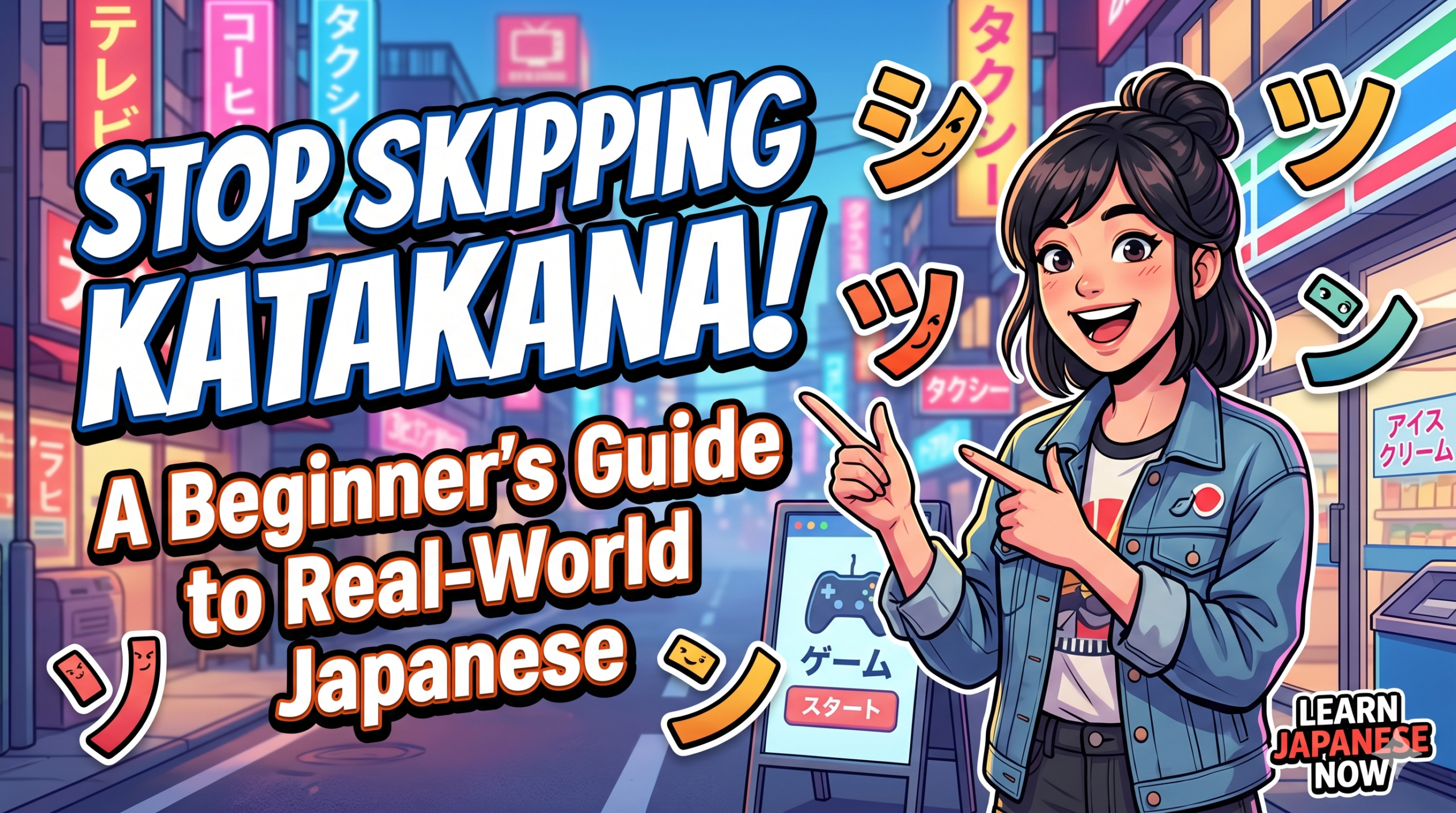
Welcome to the “Learn Japanese Now” blog! If you are just starting your journey, you have likely realized that Japanese writing is a three-headed beast: Hiragana, Kanji, and the often-dreaded Katakana.
Many beginners fall into the trap of mastering Hiragana and then treating Katakana as an “afterthought.” However, as many gamers have discovered—even those who have reached high levels like N2—Katakana is everywhere.
From video game menus to the names of your favorite snacks, Katakana is the key to unlocking modern, casual Japanese. Let’s demystify it together!

Why Katakana Feels Like a Nightmare (And Why You Should Care)
Katakana is used primarily for loanwords (words borrowed from other languages like English), foreign names, and onomatopoeia. Because it is used for “foreign” things, your brain often tries to read it as English, which can lead to confusion.
Furthermore, because Katakana characters like シ (shi) and ツ (tsu) look suspiciously similar, beginners often find them frustrating to distinguish. But don’t give up! Learning Katakana is a rite of passage.
It is the bridge between “textbook Japanese” and “real-world Japanese.” Whether you are reading a menu in Tokyo or trying to decipher dialogue in a video game like Katamari Damacy, Katakana is your best friend.
Core Examples: Katakana in the Wild
To get comfortable, you need to see these characters in context. Many Japanese words for technology, food, and hobbies are written entirely in Katakana.
Let’s look at five common examples:
- コーヒーを飲みます。 (Koohii o nomimasu.) – I will drink coffee.
- タクシーで駅に行きます。 (Takushii de eki ni ikimasu.) – I will go to the station by taxi.
- 私の名前はジェームズです。 (Watashi no namae wa Jeemuzu desu.) – My name is James.
- テレビを見ます。 (Terebi o mimasu.) – I will watch TV.
- アイスクリームが好きです。 (Aisukuriimu ga suki desu.) – I like ice cream.
Notice how these words sound very similar to their English counterparts?
That is your biggest advantage! If you are ever struggling with a specific sound or a complex grammar point, resources like JapanesePod101 offer excellent audio lessons that can help you bridge the gap between how these words look on paper and how they sound in a natural conversation.
Common Mistakes to Avoid
The most common mistake beginners make is “skipping” Katakana practice.
Do not just rely on Hiragana! Another frequent error is confusing similar-looking characters.
As mentioned earlier, シ (shi) vs ツ (tsu) and ン (n) vs ソ (so) are the “boss fights” of the Katakana alphabet. When you write them, pay close attention to the stroke direction. シ is written from the bottom up, while ツ is written from the top down.
Taking five minutes a day to trace these characters will save you hours of confusion down the road.
Practice Tips for Beginners
If you want to improve, you have to make it fun. Here are three tips to speed up your progress:
- The Labeling Method: Go around your kitchen and label items with Katakana sticky notes. Write テーブル (teeburu – table) or 冷蔵庫 (reizouko – fridge). Seeing them daily makes them stick.
- Read Video Game Menus: You don’t need to be an N2 master to play games. Even in simple games, look at the settings menu. You will see words like サウンド (saundo – sound) or コントローラー (kontorooraa – controller).
- Use Mnemonics: Don’t just memorize the shapes. Create stories. For example, コ (ko) looks like the corner of a box. Remembering these visuals helps move the information from short-term to long-term memory.
Conclusion: Keep Playing!
I know that seeing a wall of Katakana in a video game can feel overwhelming, but remember: even the person who passed the N2 level started exactly where you are right now—staring at a シ and wondering if it was a ツ.
Learning a language is a marathon, not a sprint. Be patient with yourself, keep practicing your characters, and don’t be afraid to make mistakes.
Whether you are playing games, listening to music, or just reading signs on the street, every bit of exposure counts. You are doing great—keep going, and before you know it, that “nightmare” text will become second nature!