
Welcome to Day 34 of our 100-day JLPT N5 challenge!
Yesterday, on Day 33, we mastered Japanese colors like あか (red) and みどり (green), learning how to describe things like この くるま は あおい です (This car is blue).
Today, we’re building on that foundation by diving into Japanese adjectives – the key to describing the world vividly.
Adjectives are essential for JLPT N5, letting you talk about size, feelings, or qualities, like a “big house” or a “cute cat.” This lesson introduces the two main types of adjectives (い-adjectives and な-adjectives), their grammar, and how to use them in sentences.
Let’s make your Japanese sparkle!

Why Japanese Adjectives Matter for Beginners
Adjectives are the spice of language, adding flavor to your descriptions. In Japanese, they’re a core part of JLPT N5, appearing in reading, listening, and grammar sections.
Whether you’re saying a room is “small” or a friend is “kind,” adjectives help you express observations and connect with native speakers.
This lesson builds on Day 23 (おおきい and ちいさい) and Day 33 (colors like あかい), tying together grammar rules to make your sentences natural.
Main Lesson: Understanding Japanese Adjectives Step-by-Step
Japanese has two main types of adjectives: い-adjectives (ending in い, like あかい) and な-adjectives (used with な, like げんき).
We’ll explain both, provide examples, and show how to use them in sentences.
Step 1: Types of Adjectives
い-adjectives
End in い and directly describe nouns or act as predicates. Examples include colors (Day 33) and size (Day 23).
Examples: あかい (akai – red), おおきい (ookii – big), ちいさい (chiisai – small).
な-adjectives
Require な when describing nouns and act differently as predicates. They often describe abstract qualities like feelings or states.
Examples: げんき (genki – healthy/energetic), しずか (shizuka – quiet), きれい (kirei – pretty).
Step 2: Vocabulary List
Here’s a table of JLPT N5 adjectives. We’ve included some from Days 23 and 33 for review, plus new ones.
| Hiragana | Romaji | English | Type |
|---|---|---|---|
| あかい | akai | red | い-adjective |
| おおきい | ookii | big | い-adjective |
| ちいさい | chiisai | small | い-adjective |
| たかい | takai | tall/high | い-adjective |
| ひくい | hikui | low/short | い-adjective |
| げんき | genki | healthy/energetic | な-adjective |
| しずか | shizuka | quiet | な-adjective |
| きれい | kirei | pretty | な-adjective |
| すき | suki | liked/favorite | な-adjective |
| じょうず | jouzu | skillful | な-adjective |
Step 3: Grammar Rules for Adjectives
い-Adjectives
Direct Description: [い-adjective] + [noun]
Example:
あかい くるま (akai kuruma) – a red car
おおきい いぬ (ookii inu) – a big dog
Sentence with は: [Noun] + は + [い-adjective] + です
Example:
この くるま は あかい です。 (Kono kuruma wa akai desu.) – This car is red.
この いぬ は おおきい です。 (Kono inu wa ookii desu.) – This dog is big.
Negation: Drop い, add くない.
Example:
この くるま は あかくない です。 (Kono kuruma wa akakunai desu.) – This car is not red.
Specificity: Avoid general nouns like くるま は あかい (unnatural). Use この or あの for specific items:
Correct: この くるま は あかい です。 (Kono kuruma wa akai desu.) – This car is red.
Wrong: くるま は あかい です。(Kuruma wa akai desu.) – A car is red.
な-Adjectives
Direct Description: [な-adjective] + な + [noun]
Example:
げんきな ひと (genki na hito) – an energetic person
しずかな へや (shizuka na heya) – a quiet room
Sentence with は: [Noun] + は + [な-adjective] + です
Example:
たなかさん は げんき です。 (Tanaka-san wa genki desu.) – Tanaka-san is energetic.
この へや は しずか です。 (Kono heya wa shizuka desu.) – This room is quiet.
Negation: Add じゃない.
Example:
たなかさん は げんき じゃない です。 (Tanaka-san wa genki ja nai desu.) – Tanaka-san is not energetic.
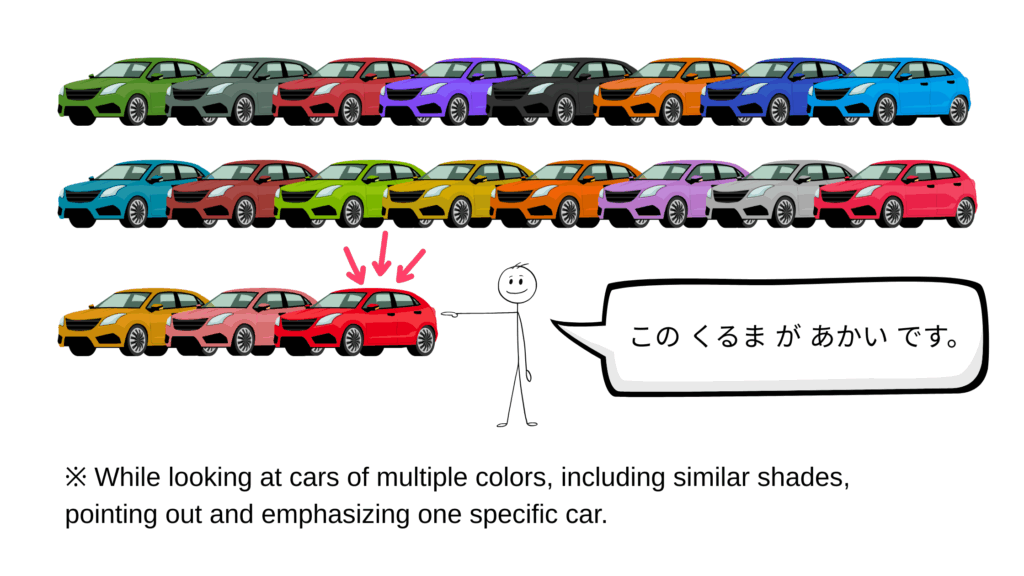
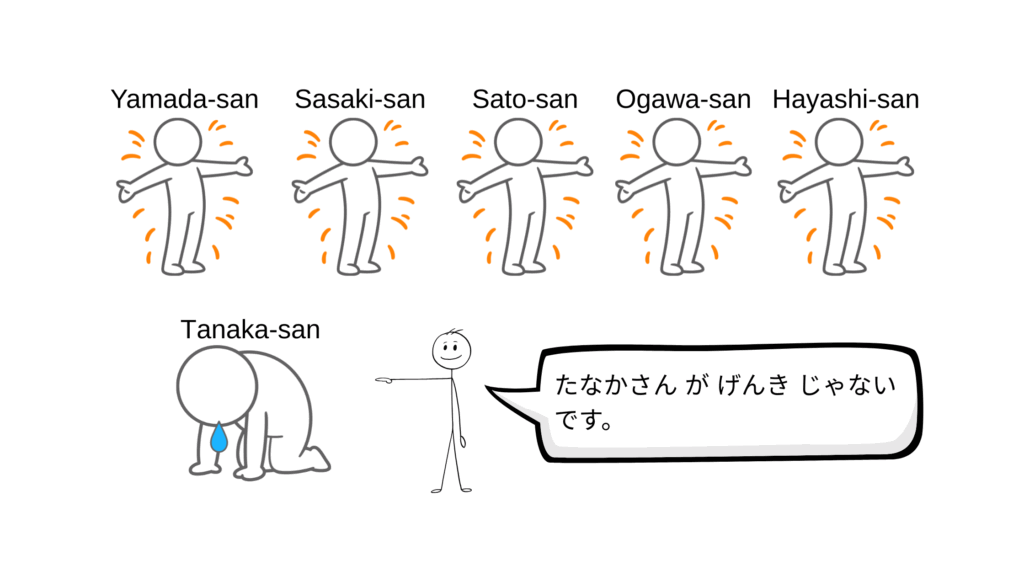
Using が for Emphasis
For both types, が can replace は to emphasize the subject or introduce new information, but は is more common for neutral descriptions.
Example: この くるま が あかい です。 (Kono kuruma ga akai desu.)
– This car is red (emphasizing this car).
Example: たなかさん が げんき じゃない です。 (Tanaka-san ga genki ja nai desu.)
– Tnaka-san is not energetic (highlighting Tanaka-san).
Step 4: Example Sentences
Here are the example sentences mixing い-adjectives and な-adjectives.
この りんご は あかい です。 (Kono ringo wa akai desu.)
– This apple is red.
この いえ は おおきい です。 (Kono ie wa ookii desu.)
– This house is big.
ちいさい ねこ を みました。 (Chiisai neko o mimashita.)
– I saw a small cat.
※ 「ちいさな ねこ」 is also okay.
この ビル は たかい です。 (Kono biru wa takai desu.)
– This building is tall.
ひくい やま が あります。 (Hikui yama ga arimasu.)
– There’s a low mountain.
げんきな こども が こうえん に います。 (Genki na kodomo ga kouen ni imasu.)
– An energetic child is in the park.
この へや は しずか です。 (Kono heya wa shizuka desu.)
– This room is quiet.
きれいな まち を あるきます。 (Kirei na machi o arukimasu.)
– I walk in a pretty town.
この たべもの は すき です。 (Kono tabemono wa suki desu.)
– This food is my favorite.
たなかさん は えいご が じょうずな せんせい です。 (Tanaka-san wa eigo ga jouzuna sensei desu.)
– Tanaka-san is a teacher skilled in English.
Practice Section: Interactive Adjective Quiz
Test your skills with this fun quiz! Choose the correct answer for each question.
Question 1: What does あかい mean?
Question 2: Translate “This house is big” to Japanese.
Question 3: Which is “a quiet room”?
Question 4: What does この ねこ は ちいさい mean?
Question 5: Which adjective needs い before a noun?
Question 6: Translate “This building is tall.” to Japanese.
Common Mistakes for English Speakers
English speakers often trip up on:
な vs. い confusion
Adding な to い-adjectives or forgetting it for な-adjectives.
Wrong: あかい な くるま.
Correct: あかい くるま.
Wrong: しずか へや.
Correct: しずかな へや.
Specificity
Saying くるま は あかい です (unnatural) instead of この くるま は あかい です. Use この/あの for specific nouns (see Days 23 and 33).
Negation errors
Using じゃない for い-adjectives.
Wrong: あかい じゃない.
Correct: あかくない.
Pronunciation
Stressing syllables like “OH-kee” instead of oh-kee for おおきい. Keep tones flat.
が vs. は
Using が instead of は for neutral descriptions. Prefer この くるま は あかい です over この くるま が あかい です unless emphasizing.
Conclusion
Amazing work on Day 34! You’ve learned the two types of Japanese adjectives – い-adjectives (e.g., あかい, おおきい) and な-adjectives (e.g., げんき, しずか) – and how to use them to describe nouns or make sentences.
You can now say この いえ は おおきい です (This house is big) or きれいな まち (a pretty town), boosting your JLPT N5 prep. Keep practicing daily – consistency is your superpower.
See you tomorrow!

